Nowadays, with such rapid changes in the workplace, just being busy is not sufficient for career achievement; the way you define "quality of work," "level of dependability," and "ability to produce quantifiably great results" determines the level of success at a given time. Therefore, the key to obtaining all three is by focusing on your time-management method instead of simply working longer hours.
When you effectively manage your time, you reduce your chance of stress, limit the number of unplanned rush jobs created, allow yourself the space needed to complete effective long-term projects, and consistently produce high-quality deliverables in your professional career.
Using these techniques will provide you with the best possible opportunity to be recognized in your role and prove your ability to realize your goals in the workplace.
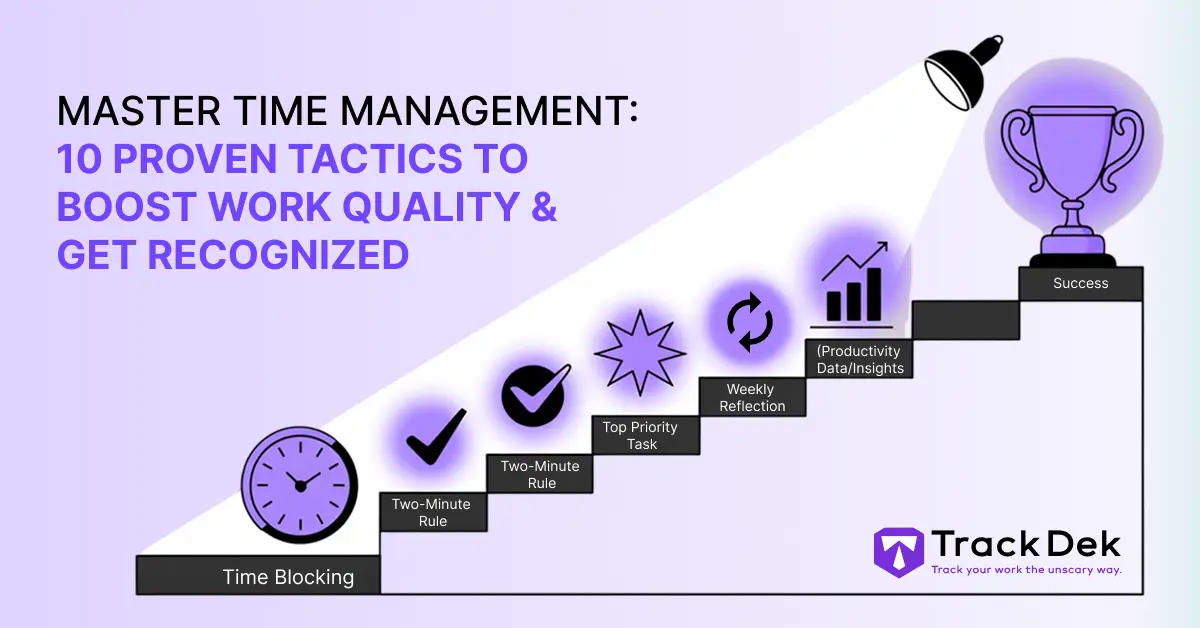
1. Schedule Tasks by Time Blocking to Improve Focus on Deep Work
Time blocking is an effective time management tool that involves creating a time schedule for specific periods of the day for the most demanding tasks without interruption.
- For example, rather than simply putting "Work on Report" on your calendar for a general time frame, you should instead put "Deep Work: Write First Draft of Q3 Report" as a scheduled task from 9:00 a.m. to 10:30 a.m.
- Time blocking also helps you avoid the problem of "context switching," which detracts from the quality of work performed. By giving yourself high-energy, dedicated time to tackle your most challenging projects, you create opportunities for better quality output.
2. Apply the Two-Minute Rule to Manage Clutter Effectively
If you can perform any given task within two minutes or less, then do it as soon as you think of it!
- You should respond immediately to simple emails, file a paper or document away, schedule a meeting via an online calendar application, or provide a couple of acknowledgement about a quick request, etc.
- Utilizing this approach will prevent ongoing clutter from building up in your mind and to-do list. This mental clarity helps you devote more time and attention to the more complex tasks that require higher quality.
3. Identify Your "Top Priority" (Top Priority Task)
Before the start of your working day, you should identify a single action that will generate the most significant effect/result. That action is your top priority.
- How It Works: The first thing to do each morning is to determine what action or activity will generate the most amount of completed results/benefits when you schedule that action during the time of day when your level of energy is at its peak level of focus. You should do everything possible to protect this "Top Priority" action from being interrupted.
- Effect of Recognition: The highest value item you complete the first time each day is subsequently what leadership will observe you doing. This is a very important "smart" work habit; consistently completing the highest value item first provides you with a means to gain the attention of leadership.
4. Grouping Similar Tasks (Process Multiple Tasks More Efficiently)
By grouping together like or similar repeated tasks, you can process them all at one time.
- How It Works: Create a time block that is designated specifically for processing emails at a specific point in time (e.g., email processing will occur from 2 PM to 3 PM, call processing will occur from 3 PM to 4 PM, and administrative processes will occur from 4 PM to 5 PM).
- Quality Impact of Grouping Tasks: Your brain will operate with greater efficiency when your brain is performing in the same "mode." Batching similar task types together will reduce ramp-up times and provide more uniformity in how all completed outputs are produced.
5. Employ the "Eat the Frog" Technique (Beat Procrastination).
Mark Twain said, "If you eat a live frog first thing in the morning, there will be nothing worse that will happen to you the rest of the day." Your "frog" is the most unpleasant or difficult task you've been procrastinating about.
- How it works: Tackle your "frog" before tackling anything else. With this in mind, the remaining part of your day will be an easier journey. You'll build momentum after completing your "frog."
- Recognition Factors: Leaders are impressed with employees who complete unsavory or challenging tasks without being prompted. This shows initiative and reliability, which are important for career advancement.
6. Keep Track of Your Distractions (Identify Your Time Sinks).
You can't measure what you can't see. Use simple tracking (e.g., a notes app or physical journal) for one week to identify when and why you distract yourself.
- How it works: Write down every time you check social media, get caught in an unplanned conversation, or browse the internet.
- Quality Factors: When you recognize your personal time sinks, you can create specific defensive strategies (e.g., mute Slack notifications, block websites) so you have time available to focus on the quality of your work.
7. Master the Skill of Refusing Requests (Protect Your Focus).
The biggest enemies of your quality of work are interruptions that come out of nowhere and requests for your lowest priority works.
- How to Master This Skill: When someone asks you for help or to take on an assignment when it does not line up with your MITs or current priorities, politely say "no" and possibly provide them with alternatives (e.g., "I will look at that tomorrow at 11 AM" or "I cannot take that on, but I can point you to the resource").
- What You Gain in Terms of Recognition: By demonstrating to your boss and co-workers that you are taking steps to protect your time in order to produce the best quality of your core projects, you demonstrate that you understand your priorities and those of the organization.
8. Schedule Buffer Periods (Reliability Factor).
When you schedule out your major tasks, do not schedule them back-to-back with no time between each. Make sure you build in at least 15 minutes of time between each major block.
- How to Make This Work for You: If a meeting runs over or a task takes you 10 minutes longer than planned, your entire day is not thrown off track because you have time built in for breaks and preparation for your next task.
- What You Gain in Terms of Recognition: With buffer periods, you will rarely be late for anything, you will rarely feel rushed, and you will consistently deliver on time. Reliability is one of the fastest ways to make yourself stand out at work.
9. Apply Insights from Your Productivity Data (Improvement through Data).
Identify the exact way you spend your time. Where did you spend all your time?
- The methodology: The productivity insights provided by TrackDek will provide insight on how long you have spent using different software applications and what your actual focus timeframe was.
- The quality-related outcome: By having self-awareness to help create a targeted performance enhancement strategy, you can determine exactly when you perform the best and arrange to schedule your most intensive work during this timeframe (i.e., if you know that you work best from 9:00 AM to 11:00 AM, you should schedule your most challenging tasks during that time period).
10. Weekly Reflection and Review (Ongoing Professional Development).
After the workweek is over, set aside 30 minutes to evaluate your time logs for the week, the accomplishments you achieved, and any mistakes you may have made.
- Process: What worked? Where did I spend too much time? What can I improve on next week to improve my work performance?
- Recognition impacts: Developing this habit allows you to demonstrate to others that you are committed to developing yourself, and being proactive versus reactive are primary characteristics of a successful leader of the future.
Adopting the time management tips provided herein as part of your daily routine will not only allow you to regain lost time but will also significantly impact the quality and quantity of everything you do.